Straw Bale Homes
Walls of stacked straw bales, plastered inside and out, cheap agricultural waste turned into thick, cozy, super-insulated walls. Keep them dry and they last decades.
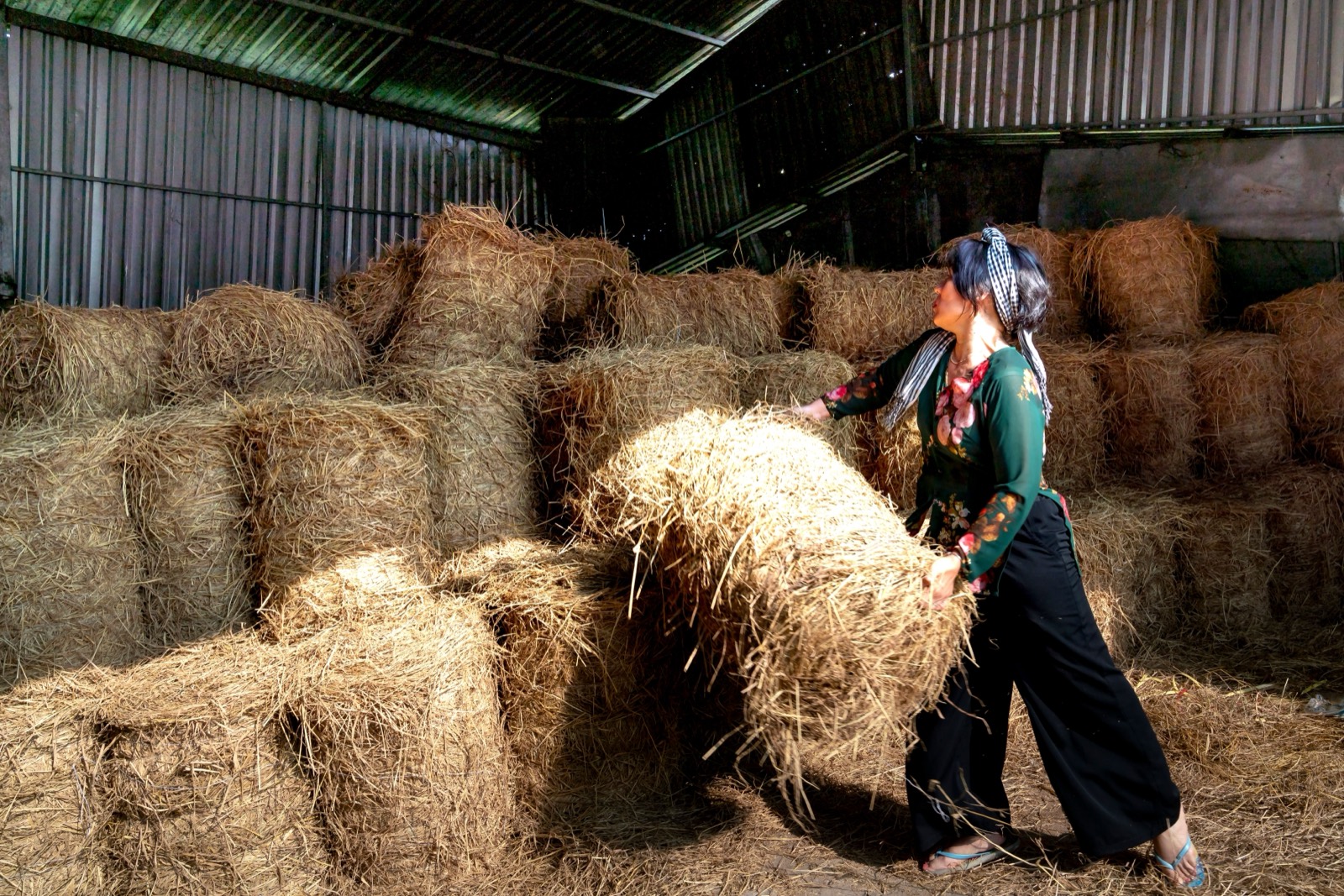
- Bales stacked like huge bricks, then plastered both faces. The plaster skins carry the load; the straw is the insulation core.
- Owner-built with volunteer labour it runs $32–$80 per sq ft. Hire a professional crew and it is $150–$400, because almost nobody does this for a living.
- Measured wall performance is R-26 to R-30 — roughly double a code-built wall. That is a prize in Nebraska. It is a smaller prize eleven degrees off the equator.
- Bales must arrive under 15% moisture and fungal decay starts above 20%. Five points is your entire safety margin.
- Never use Portland cement stucco. It traps water inside the wall and rots it from within.
Straw bale building stacks the leftover stalks of a grain harvest into thick walls and wraps them in lime or earth plaster. You get a super-insulated, carbon-storing, genuinely lovely wall for the price of agricultural waste. The oldest plastered straw bale buildings still standing in Nebraska were put up in 1903. One variable decides whether yours joins them or turns to compost, and this guide is mostly about that variable.
How it goes together
Bales get stacked like oversized bricks, either load-bearing, where the bales carry the roof, or more commonly as infill inside a timber frame. They are pinned, compressed, and then rendered on both faces.
The finished wall is best understood as a sandwich panel. The plaster skins do the structural work. The straw in the middle is the insulation and the spacer. That is why the plaster specification matters more than the bales do.
Underneath and above, two details carry the whole building: a raised plinth of at least 300 mm from slab to grade, and roof overhangs of 600 mm or more. Builders call it a good hat and good boots. Buildings that have both, plus vapour-open plaster, have documented service lives past a hundred years.
What a straw bale house costs
The bales are almost free. Bales run $5 to $15 each, and a 2,000 sq ft house needs somewhere around 300 to 500 of them. Call it a few thousand dollars for the entire wall material of a home.
Then reality arrives. Labour is 30 to 40% of construction cost on any house, and straw bale is labour-heavy: hand-stacking, pinning, and two coats of hand-applied lime or earth plaster inside and out. Lime plaster is slower and dearer than drywall, and it is the part you cannot cheap out on.
So the range is enormous and it tracks one thing — who swings the hammer:
- $32–$80 per sq ft if you build it yourself with a bale-raising crew of friends.
- $100–$200 per sq ft for a mixed build, competitive with mid-range conventional construction.
- $150–$400 per sq ft for a fully professional build, because straw bale is a niche trade and an experienced general contractor is hard to find and prices accordingly.
Budget another $80 to $200 per zone for in-wall moisture sensors. Skip them and you will not find out you have a problem until the plaster stains.
The five points of margin
Everything about straw bale comes down to two numbers, and they sit uncomfortably close together.
Bales are specified to arrive at under 15% moisture content. Fungal decomposition kicks off once moisture in the bale mass climbs above 20%. That gap is the entire safety margin of the method, for the life of the building.
Every design decision on a straw bale house — the plinth height, the overhang, the plaster, the flashing — exists to defend those five points. Thresholds are the delivery specification and decay onset used in straw bale construction guidance.
The plaster is where most failures are born. Portland cement stucco is the classic mistake. It looks tough and it is exactly wrong: cement is relatively vapour-closed, so any moisture that gets into the bale cannot get back out, and the wall quietly composts behind an intact-looking finish. Lime and clay plasters breathe, which is the entire point.
Straw bale, rated
| Factor | Rating | Notes |
|---|---|---|
| Material cost | 🟢 | $5–$15 a bale. The walls of a house for a few thousand dollars |
| Built cost | 🟡 | $32–$80/sq ft self-built, $150–$400 with a professional crew |
| Insulation | 🟢 | R-26 to R-30 measured, roughly double a code wall |
| Value of that insulation here | 🟡 | Superb in a heating climate. Useful but oversold near the equator |
| Sustainability | 🟢 | Stores carbon and uses a genuine waste stream |
| DIY-friendly | 🟢 | Stacking is intuitive; bale-raisings are a real tradition |
| Fire | 🟢 | Plastered bales are too dense to feed a fire |
| Humidity | 🔴 | The five-point margin has to hold in air that sits above 85% RH |
| Driving rain | 🔴 | One flashing failure can end a wall |
| Pests | 🟡 | Sealed and plastered keeps rodents and insects out |
| Permitting & finance | 🟡 | Increasingly code-recognised, but varies enormously by jurisdiction |
Who actually builds it
Straw bale is one of the friendlier natural methods to attempt. Stacking bales is intuitive, community bale-raisings are a genuine tradition, and the skill barrier for the walls themselves is moderate.
The skill that matters is not stacking. It is moisture detailing: the plinth height, the overhang depth, the plaster specification, and flashing that never lets a drop into the wall. That work is unglamorous, invisible when done right, and fatal when done wrong.
Which leads to the practical problem in Panama and Costa Rica. There is no local straw bale trade. There is no supply of construction-grade baled straw at a scale that matters, because this is not a grain-farming region. And a builder who has never detailed a bale wall is being asked to protect a five-point margin on their first attempt, in the least forgiving climate for it.
Does it belong here?
Be honest about what you would be buying. The headline benefit of straw bale is an R-26 to R-30 wall, and that number was worth its weight in a Nebraska winter, which is precisely where the method was invented. In a climate where you never heat a building, super-insulation still trims your air conditioning load, but it is no longer the reason to accept the risk.
Meanwhile the risk is real and specific. You are asking a hygroscopic material to hold below 20% moisture in air that sits above 85% relative humidity for months at a stretch, through afternoon rain that arrives sideways. It is worth saying plainly that we could not find rigorous peer-reviewed hygrothermal modelling of straw bale walls in hot-humid zones. The absence of that research is itself a finding: nobody has demonstrated it works here at building-science standards.
Could it be done? Yes, with a very high plinth, very deep overhangs, breathable lime plaster, embedded sensors and an owner who inspects. Would we recommend it for a house you are buying from six time zones away? No. If the appeal is a thick, natural, beautiful wall in this climate, look at bamboo and guadua, which already grows here, or at the full method comparison before you commit.
Want a natural-material house that survives the rainy season?
We build in reinforced concrete by default and we will happily talk you out of a method the climate is going to eat. If natural materials are the point for you, we can price the versions that actually last here.
See real 2026 build costs →Frequently asked questions
Are straw bale walls a fire risk?
No, and the reason is packing density. A tightly compressed bale has almost no oxygen moving through it, so it smoulders rather than burns, and the plaster skins add a rated protective layer on both faces. Loose straw is flammable. A finished straw bale wall is not.
What does a straw bale house cost?
It depends almost entirely on who builds it. Owner-built with volunteer labour runs roughly $32 to $80 per square foot. A mixed build lands at $100 to $200, competitive with mid-range conventional. A fully professional build is $150 to $400, because straw bale is a niche trade and experienced contractors are scarce.
At what point does straw actually rot?
Fungal decomposition begins once moisture content in the bale mass rises above 20%. Bales are specified to arrive under 15%. That five-point gap is the whole safety margin, and every design detail on the house exists to protect it.
Why can’t I use normal cement stucco on it?
Because cement is relatively vapour-closed. Any moisture that finds its way into the bale cannot escape, so the wall decays from the inside while the finish still looks perfect. Lime and clay plasters let the wall breathe, which is why they are specified instead.
Can you build a straw bale house in humid tropics?
It is the hardest natural method to pull off here. You need a plinth of at least 300 mm, overhangs of 600 mm or more, breathable plaster, embedded moisture sensors and a real inspection habit. There is also no meaningful peer-reviewed hygrothermal research on straw bale in hot-humid climates, and no local supply of construction-grade bales in Panama or Costa Rica.
Sources & verification
Figures in this guide were checked against primary and authoritative sources on 6 September 2026. Immigration, tax, and cost figures change — always confirm the current rules with the official body or a licensed professional before acting.
- Building Science Corporation, BSD-112 — building science for strawbale buildings
- House of Straw — measured R-values, bale specification and plaster guidance
- Building Renewable — cost breakdown by build method