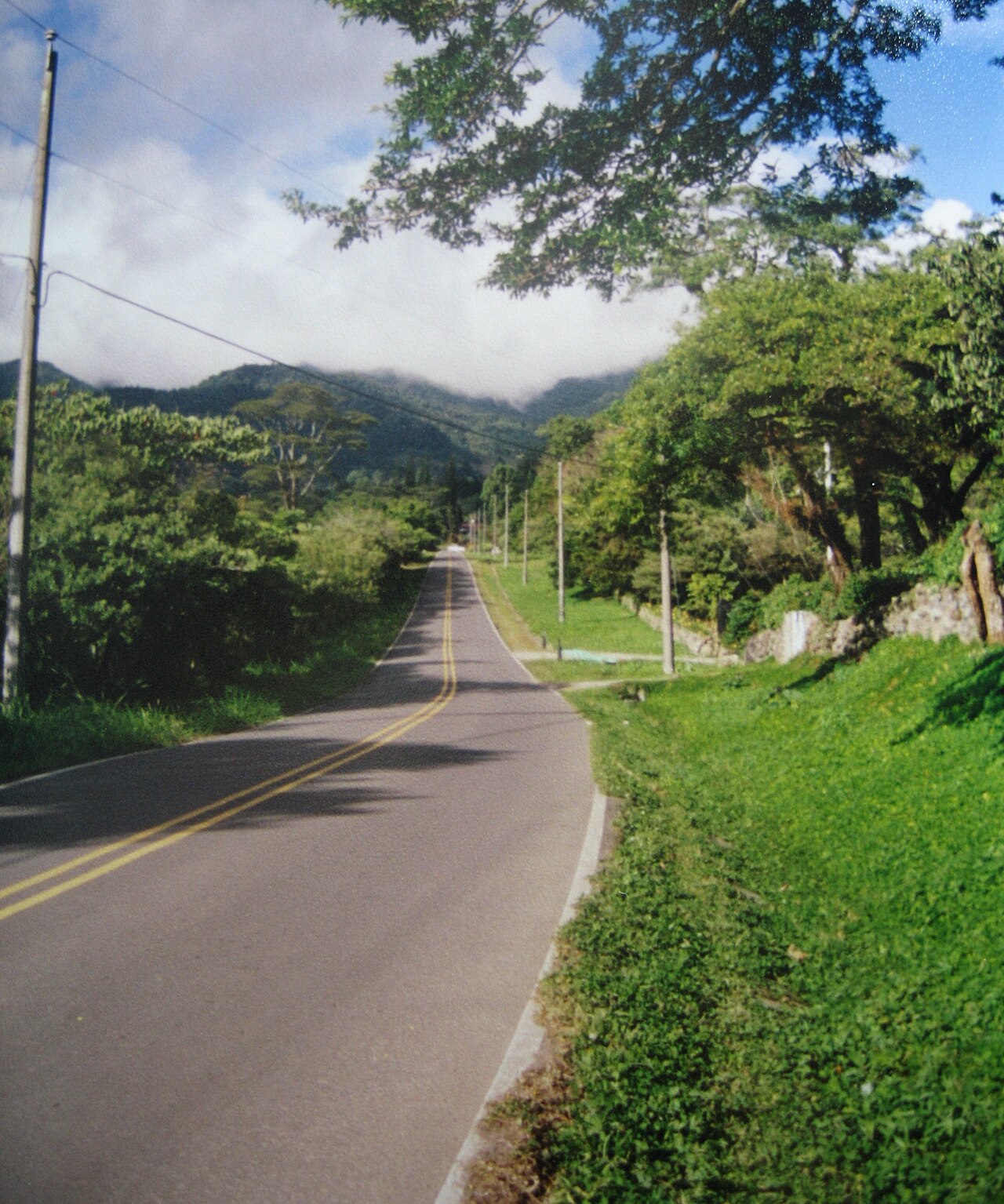
There is a particular kind of morning in Boquete: coffee on a porch, the air cool enough for a light sweater, birdsong instead of traffic, and a volcano at the end of the street. This guide covers what is worth knowing before you decide this is where you build: the land, the climate, the history, the neighborhoods, daily life, real costs, and the legal path from here to keys in hand.
Key Takeaways
- The climate is the whole pitch. At 3,300–5,900 ft, Boquete runs 60–80°F all year: no AC, no heating, no tropical swelter.
- A couple lives well on ~$2,200–$3,200/month. Utilities are famously tiny (~$25–$58) because nobody needs to cool a house here.
- Foreigners buy with full rights. The one rule that matters: get titled land, never just possession rights (derechos posesorios).
- Building runs ~$700–$900/m² (about $65–$84/sq ft) for good quality; titled town lots $40–$85/m².
- It's the coffee capital of the planet, and a town that's spent 20 years learning how to welcome newcomers.
A Volcano's Permanent Spring
Why the elevation is the whole story.
Boquete sits at 3,300 to 5,900 feet on the shoulders of Volcán Barú. At 11,401 feet, Barú is Panama's highest point, and the only spot in the country where a clear day shows you both the Pacific and the Caribbean at once. The elevation buys the valley a permanent spring: cool mornings, warm afternoons, average lows near 60°F and highs near 80°F, with none of the tropical swelter that defines the rest of the country.
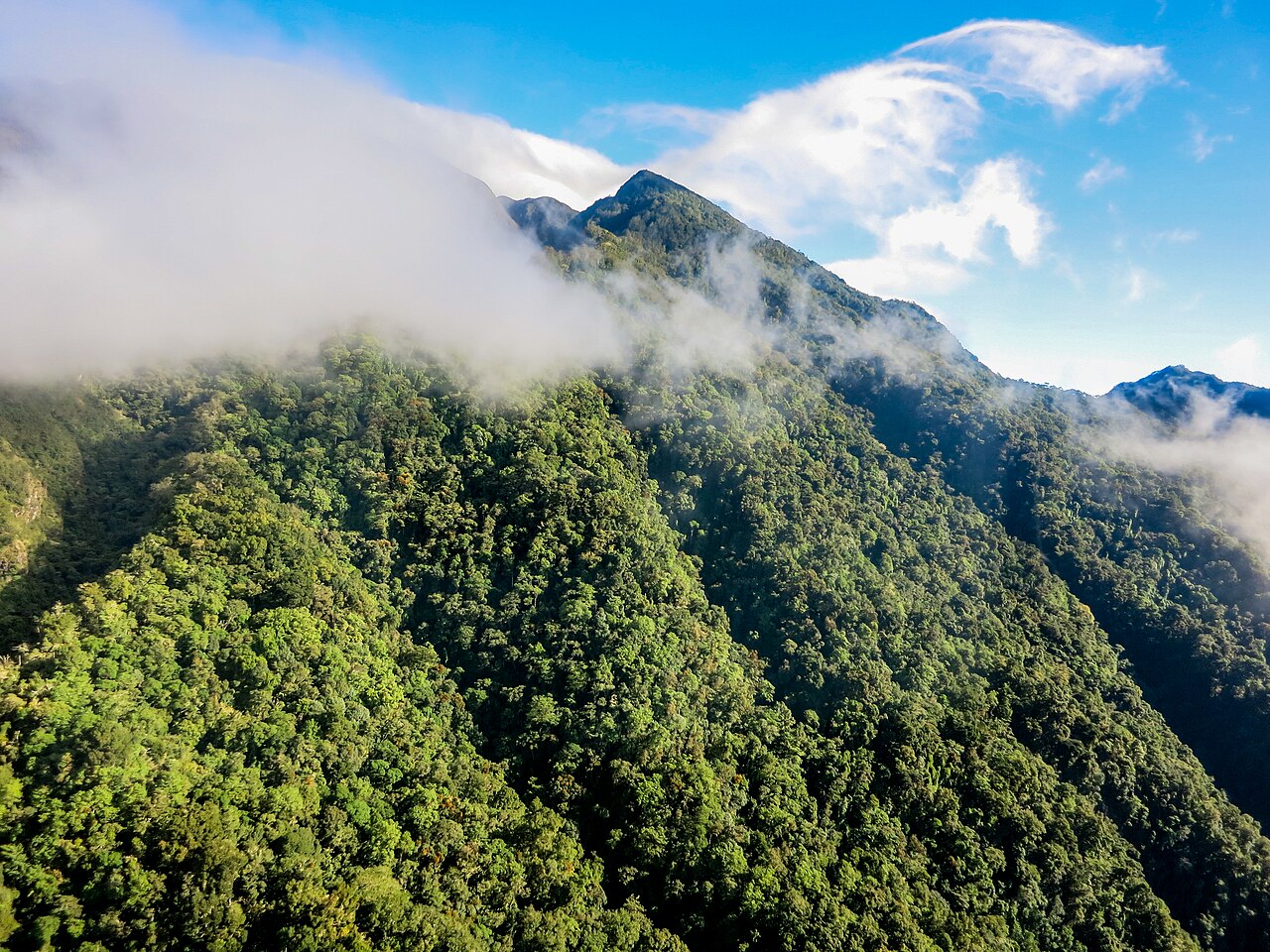
Volcán Barú, seen up close through cloud. Coffee is grown on its slopes between 1,500 and 1,700 meters, where a wide day-to-night temperature swing is exactly what gives the coffee its flavor.
The valley's volcanic ash soil is rich in minerals. The same conditions that make the coffee legendary make the whole landscape lush: flower plantations, dense forest, rivers running down from the peak. The climate is mild enough that most homes need neither air conditioning nor heating, ever. Rain falls, but rarely violently, and the dry season (roughly mid-December through April) is when the valley is at its most postcard-perfect.
The one honest caveat on the land itself: this same volcanic, well-watered terrain sits on active geology, and homes here should be built to the same earthquake-conscious engineering standards used across Panama's highlands. It is a permanent design constraint, not a one-time checkbox.
A Refuge, Then a Coffee Town
From Ngäbe sanctuary to the birthplace of the world's most expensive coffee.
Long before it was a retirement destination, the Boquete highlands were a refuge. Archaeological evidence places settlement in the area as far back as 600 BC, and petroglyphs survive near Caldera from those early chiefdoms. When Spanish colonization intensified along Panama's coasts in the 1500s, the Ngäbe people, whose territory once stretched from the Pacific to the Caribbean, retreated into these mountains to survive.
For centuries colonists wrote the terrain off as worthless and impassable, which left the Ngäbe, and for a time the Miskito from the Caribbean side, in relative peace. There is a quiet irony in that: the same isolation that sheltered them for three hundred years is exactly what makes Boquete feel so removed and calm when you arrive today.
That isolation broke down in the second half of the 19th century. Settlers arrived from nearby Bugaba, Gualaca, and David, alongside a wave of European immigrants: Yugoslav, French, German, Swiss, and Swedish families, plus Americans. They all came for the same reason. The volcanic soil promised coffee. The District of Boquete was formally founded on April 11, 1911, with early townships at Bajo Boquete, Caldera, and Palmira, expanding later to Alto Boquete, Jaramillo, and Los Naranjos in 1998.
How a "bad" coffee variety became the world's most expensive
The origin of Geisha coffee, the variety that made Boquete world-famous, starts far away, in Ethiopia's Gori Gesha Forest, where it was discovered in the 1930s. Seeds traveled through Tanzania and eventually to a research center in Costa Rica. In the early 1960s, a Boquete agriculturist named Pachi Serracín (Don Pachi) brought it home while searching for a variety resistant to coffee leaf rust. Geisha had a bad reputation: low yields, oddly tall trees, strange flavors, and it never caught on. For forty years, almost nobody wanted it.
Then, in 2004, Hacienda La Esmeralda entered a "rediscovered" lot of Geisha into the Best of Panama auction. It sold for a then-unheard-of $21 a pound, a world record at a time when top lots fetched $2 to $4. That single moment triggered the Geisha boom, and prices have climbed ever since: $601 a pound in 2017, then $1,029 by 2019.
The current record is almost hard to type. In August 2025, a 20-kilo lot of washed Geisha from Hacienda La Esmeralda sold at Best of Panama for $30,204 per kilogram, about $13,705 a pound. That is $604,080 for the lot, bought by a single buyer in Dubai. It scored a near-perfect 98 out of 100, the highest ever for a washed Geisha (UPI). Boquete has earned the nickname "the Napa Valley of coffee," and farm tours, where you watch the harvest, the washing, and the cupping, are now a real part of the local economy.
Which Part of Boquete
Every valley town has a downtown and a hillside. Boquete has several of each.
"Boquete" is really a district made of distinct corregimientos, each with its own character. Knowing them matters more here than in most towns this size. The differences in altitude, land price, and daily life are real.
| Area | Character |
|---|---|
| Bajo Boquete ("Lower Boquete," downtown) | The town itself, where the highway from David ends. Seat of the municipal government, most restaurants, shops, and services, the Caldera River running through it. What most people picture when they picture Boquete. |
| Alto Boquete | A separate corregimiento since 1998, despite the name ("high") it isn't actually the highest area, a common point of of local confusion. |
| Palmira | One of the oldest named settlements in the district, dating to at least 1907 under its former name, Palos Bobos. |
| Jaramillo (Abajo, Centro, Arriba) | Large, mountainous, and rural — big properties, big homes, working coffee farms and fincas. Named after a person, not a landscape feature. Home to farm-to-table dining. |
| Volcancito | On the west side of town toward Volcán Barú itself, with coffee plantations and fincas; most properties here run $100,000 and up. |
| Bajo Mono | 4,000–6,000 feet, cool year-round, waterfalls, a river valley, howler monkeys, and the trailheads for the Quetzal and Pipeline trails. Luxury and nature side by side, 15–20 minutes from downtown. |
| Caldera | One of the three original 1911 townships; more rural, further from the town center. |
Local buses run loops out of downtown to most of these areas. The Bajo Mono minibus and the Volcancito/El Salto route both run daily, the latter a full loop for $3. Two drives are worth doing for their own sake: the Volcancito–Palmira loop and the Volcancito–El Salto loop. Both wind through the coffee farms and hotel-dotted hillsides that make up Boquete's postcard image.
A Town That Already Knows How to Welcome You
Twenty years of practice, and it shows.
Roughly one in four residents of the district was born somewhere else, mostly the United States, Canada, and Europe, making Boquete home to one of the largest English-speaking expat communities in Central America. That community has spent two decades building its own infrastructure: English-language church services, a weekly Tuesday market, hiking and birding clubs, active Facebook groups numbering in the thousands, and clinics accustomed to explaining things in English. Arriving here does not feel like being a pioneer. It feels like joining a town that has been rehearsing this welcome for a long time.
"You're not the first foreigner to fall in love with Boquete. You're the latest in twenty years of them, and the town has learned how to hold that well."
None of that comes at the cost of authenticity. This remains a real Panamanian farming town. Coffee on the hillsides, a Sunday market with more Spanish spoken than English, and a volcano at the end of nearly every street reminding you exactly where you are. Roughly 40% of buyers here pay cash, closings often taking as little as 30 days, a sign of just how settled and confident the local market has become.
The Napa Valley of Coffee
And the festival that draws 100,000 people to prove it.
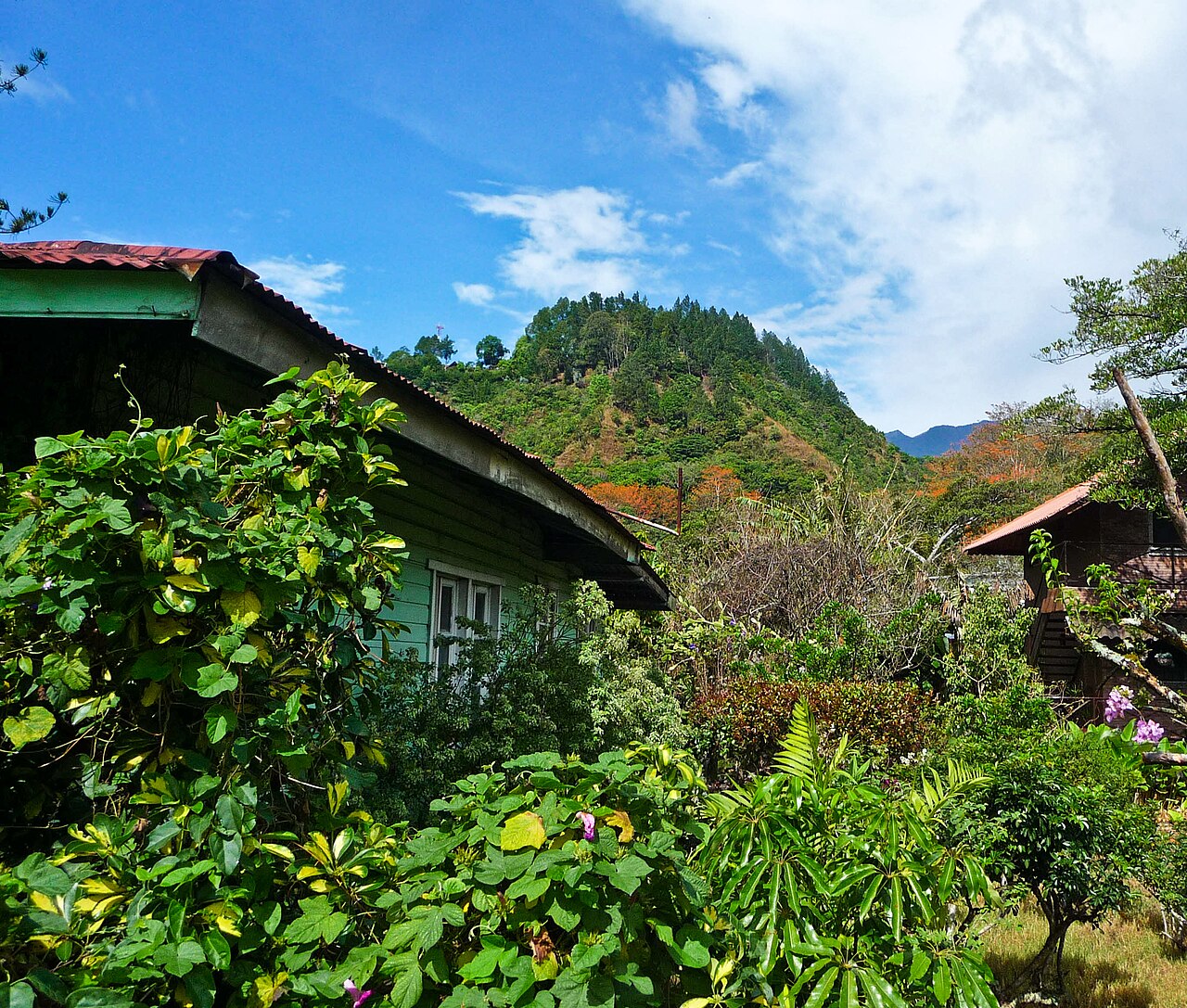
A home tucked into the hillside greenery outside town: the everyday scenery of Boquete's coffee country.
Jaramillo in particular has built a small farm-to-table food scene around its coffee estates: seasonal, local ingredients, and the chance to eat a meal grown within sight of where it's served. Beyond Geisha, Boquete grows the full range of specialty coffee. Touring a working farm is one of the area's signature experiences: the harvest, the wet or dry processing, the cupping. People who have lived here for years still do it.
The Flower and Coffee Fair
Every January, Boquete hosts the Feria de las Flores y del Café on the banks of the Caldera River. The twelve-day celebration has run in some form since 1950 and now draws over 100,000 visitors. Expect elaborate floral displays, orchids and roses and tropical blooms grown for the occasion. Also coffee tastings from the very farms surrounding the fairgrounds, traditional music and folk dance, an artisan market, and an amusement park that opens after dark. It's the single clearest annual expression of the two things this valley is actually known for, and it's earned Boquete the nickname "the Flower Capital of Panama."
What a Month Actually Costs
Cheaper than Panama City, pricier than the small towns nearby.
Boquete is not the cheapest town in Panama. Strong expat demand pushes housing, dining, and even groceries above nearby towns like David, Volcán, or Dolegá. But set against Panama City, or against life in the U.S. or Canada, it remains a genuinely affordable place to live well.
| Category | Typical cost |
|---|---|
| Groceries, one person | ~$268/month (vs. $291 in Panama City) |
| Inexpensive meal out | $6.50–$7 |
| Three-course dinner for two, mid-range | under $30–$40 |
| Domestic beer at a restaurant | ~$2 |
| 1-bedroom apartment, center | ~$725–$757/month |
| Utilities, 85m² home (no AC needed) | $25–$58/month |
| Total monthly budget, a couple | $2,200–$3,200 comfortably; some report ~$2,500 |
The reason the utility number stays so low is the same reason people move here in the first place: at this elevation, nobody needs air conditioning, and heating is rarely necessary either. It's a quiet, compounding saving that shows up every single month for as long as you live here.
Buying, Building, Visas & Money
What actually determines whether this happens.
Forty minutes down a good four-lane road sits David, Panama's third-largest city, with private hospitals, specialists, a real airport with daily flights to Panama City, and the everyday shopping a family needs. Serious specialist care means the five-hour drive to Panama City itself, the honest tradeoff for living somewhere this beautiful and this small.
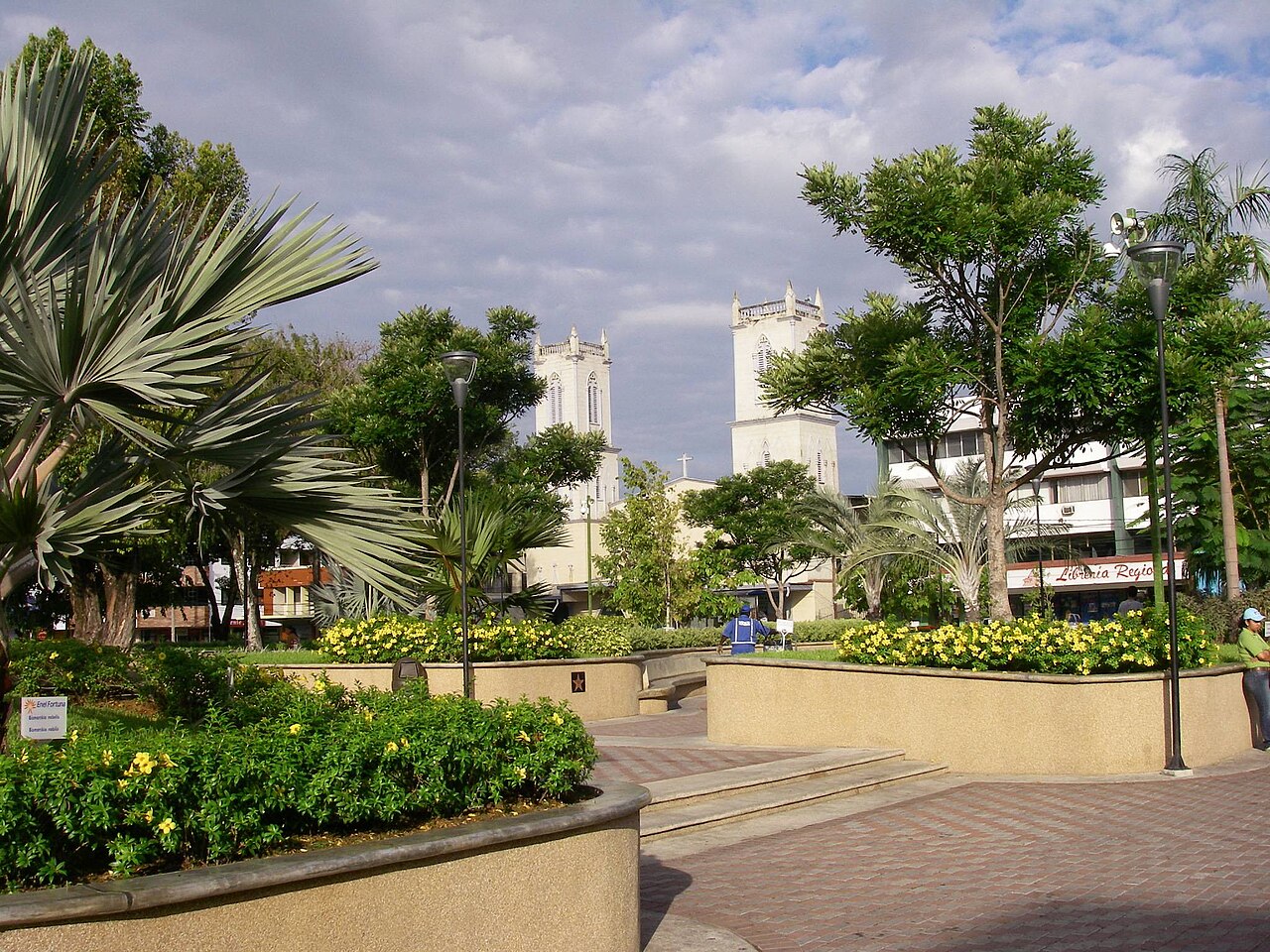
David, Chiriquí's capital, forty minutes down the mountain. Home to the region's hospitals, airport, and everyday shopping.
Land & Building, At a Glance
- Land, titled lots near town
- $40–85 per square meter
- Land, larger rural parcels
- $15–45 per square meter
- Building, good quality
- $700–900 per square meter (~$65–84/sq ft)
- Property tax
- 0.6–0.8% annually
- Market in 2026
- median sale near $265,000; inventory is short, so new builds tend to be worth more than they cost the day they're finished
The dirt is cheap; the house is the expense. Building runs roughly ten times more per square meter than the land it sits on. That's why the smart money here spends carefully on the lot and seriously on the build.
Buying the land itself
Foreigners hold the same full titled-property rights as Panamanian citizens, no residency required to buy. One distinction matters enormously. Confirm the land is fully titled, meaning registered at the Registro Público, which anyone can verify there for a small fee. What you want to avoid is land held only as derechos posesorios, possession rights. Those are common on the edges of Boquete's rural areas, and they are not ownership. A local, independent survey confirming boundaries match the registered plan, and a title search through a Panama-licensed attorney, are the two steps worth never skipping.
Residency & visas
You don't need residency to buy or build here. But it unlocks far better bank financing, and it ends the visa runs.
For most people the natural fit is the Friendly Nations Visa, open to citizens of more than 50 countries including the U.S. You qualify on any one of three routes:
- $200,000 in titled real estate, the most common path here.
- $200,000 in a three-year fixed bank deposit. The money stays yours and earns roughly 3.75–5.5%.
- A genuine Panamanian employment contract.
Since 2021 it runs in two steps: two years of provisional residency, then permanent. Citizenship becomes possible five years after that. Budget 3 to 5 months and $5,000 to $10,000 in legal and government fees.
Investing more? The Qualified Investor Visa grants immediate permanent residency at $300,000 in real estate. That threshold is scheduled to rise to $500,000 in October 2026, which is worth knowing if you are anywhere near the line.
Our Panama residency requirements guide compares every route side by side, and Boquete real estate has current prices by neighbourhood.
Financing
Panama has a genuine mortgage market for non-residents: typically 30–40% down, 7–9% interest, 25-year maximum terms. Residency changes the math substantially, 10–20% down and 4–5.5% interest once you have a local financial footprint. Seller financing is common, especially on land. Panama's Preferential Interest Rate Law subsidizes rates as low as 4% for 7 years on new titled homes priced $80,000–$120,000, worth knowing if buying new construction from a builder rather than commissioning your own.
Before you wire a single dollar
- Confirm the land is fully titled at the Registro Público, never derechos posesorios alone
- Hire an independent surveyor to confirm boundaries match the registered plan
- Use a Panama-licensed attorney for the title search and closing, not the seller's agent
- Build a clean, well-documented paper trail if funding the purchase from crypto, since every visa and bank application will ask where the money came from
- Budget the 10% construction contingency every honest local builder will tell you to add
The Things People Actually Ask
Short answers to the five questions that come up before anyone books a flight.
Is Boquete expensive to live in?
Pricier than nearby David or Volcán, cheaper than Panama City, and a bargain against most of the U.S. A couple lives comfortably on about $2,200–$3,200 a month. The sneaky saving: utilities run just $25–$58, because at this elevation you never turn on an air conditioner.
Can foreigners buy property here?
Yes. Foreigners get the same full titled-property rights as Panamanians, and you don't need residency to buy. The one rule that matters: buy titled land registered at the Registro Público, never land held only as derechos posesorios (possession rights), which is common on Boquete's rural edges. Our guide to buying land in Panama walks through the checks.
What does it cost to build a house?
Good-quality construction runs about $700–$900 per square meter ($65–$84/sq ft) in 2026. Titled lots near town go for $40–$85/m². We break the numbers down in what it costs to build a house in Panama.
Is Boquete better than the beach towns?
Different animal entirely. Think mountains and spring weather instead of sand and heat. If you're torn, Boquete vs. Pedasí compares the two head-to-head.
What's the weather really like?
Permanent spring: lows near 60°F, highs near 80°F, all year, no AC or heating. The dry season (mid-December to April) is the postcard stretch; the rest of the year is green and gently wet.
Building in Boquete?
SORA builds homes in the Chiriquí highlands, so the numbers on this page come from real projects, not brochures. If you're weighing a lot or a build here, see how we approach a build or reach out — we'll give you the honest version, land trap warnings included.