Flat Roof vs Pitched Roof
A usable concrete deck you can walk on, or a sloped roof that sheds tropical rain by gravity. Both are everywhere in Latin America. The choice is drainage, space, and style.
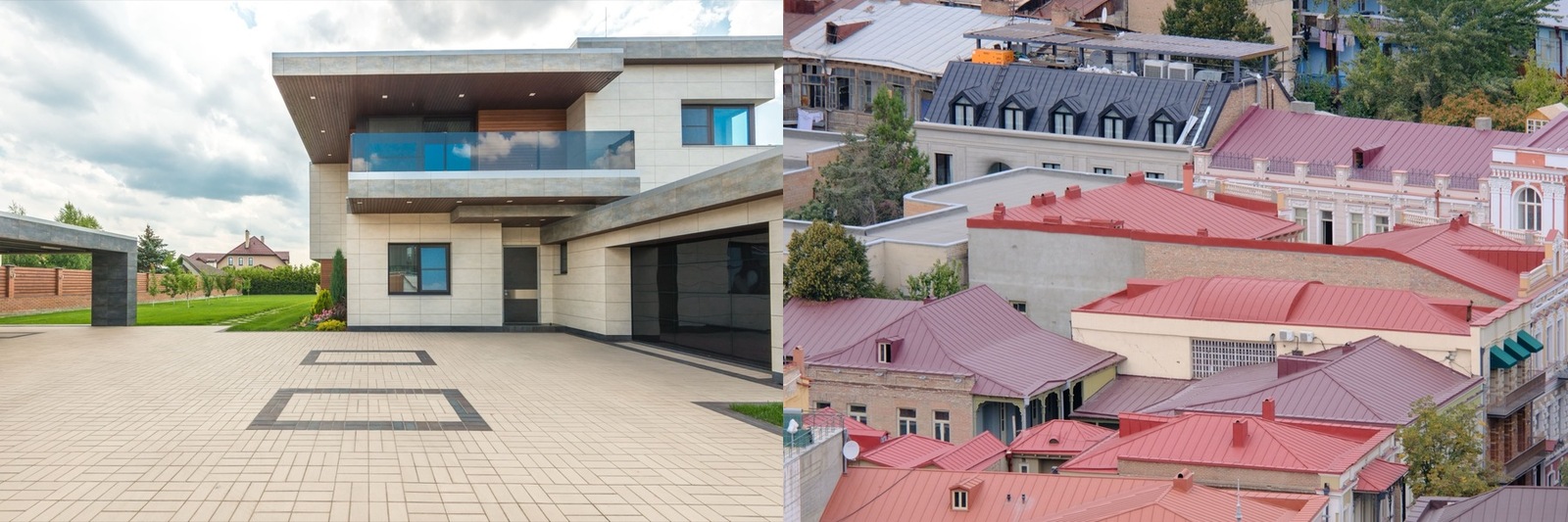
A flat roof, the concrete losa that's everywhere in Latin America, gives you a walkable deck and a modern line. A pitched roof sheds rain by gravity and hides its structure. Both are common in the tropics, and both work. The decision comes down to drainage, usable space, and the look you want.
Key takeaways
- Pitched is the lower-risk roof. Gravity never needs maintenance, never gets forgotten, and never has a bad day on site.
- Flat concrete buys you a whole floor of usable space for the price of the slab, plus a future second storey if you want one.
- In Panama, structure runs roughly $69 to $116 per square meter depending on the slab system, with waterproofing adding about $10 on top.
- The membrane is the real decision. A cheap coating may give you 5 years. EPDM rubber can give you 50. That gap is bigger than the cost gap between the two roof types.
- No flat roof is actually flat. It needs at least a 1:50 fall, and nothing should sit in a puddle for more than 48 hours.
Directly compared
| Factor | Flat roof (losa) | Pitched roof |
|---|---|---|
| Drainage | 🔴 Relies on membrane, drains, slope | 🟢 Sheds rain by gravity |
| Usable space | 🟢 Walkable deck / terrace / future floor | 🔴 Attic or void only |
| Cost | 🔴 Higher (slab + waterproofing) | 🟡 Varies by material |
| Leak risk | 🟡 Membrane must be maintained | 🟢 Lower; water runs off |
| Hurricane / wind | 🟢 Nothing to lift (slab) | 🟡 Depends on material and anchoring |
| Heat | 🟡 Mass holds heat; needs insulation | 🟡 Depends on material and attic venting |
| Look | 🟢 Modern, minimalist | 🟢 Classic and varied |
What a concrete roof actually costs in Panama
Ask three contractors what a losa costs and you'll get three answers, all of them confident. Here's the boring, checkable version: Panama's published construction price references put the structural slab in a fairly narrow band, and the system you choose matters more than the neighborhood you build in.
Two things jump out. First, the spread between the cheapest and most expensive slab system is under $50 per square meter, which on a 150 m² house is about $7,000. Real money, but not the deciding factor most people assume it is. Second, waterproofing looks almost free next to the concrete. It is not free. It is the part that fails.
For the whole-house picture rather than just the roof, see our 2026 cost to build in Panama breakdown.
The membrane is the whole gamble
Here's the thing nobody tells you at the quote stage. A flat roof isn't concrete keeping the water out. It's a thin layer on top of the concrete keeping the water out, and how long that layer lasts depends entirely on which one you bought.
Tropical conditions attack all four in the same three ways. Constant humidity feeds mold, mildew and algae that eat at the surface. UV cooks the top layer year round, with no winter off-season. And any water that ponds instead of draining sits there stressing the same patch until something gives.
The practical version: if you're building a flat roof you intend to keep, the membrane is not the place to accept the cheapest line on the quote. The difference between a five-year coating and a proper rubber membrane is a few thousand dollars once. Redoing a failed roof, and the ceiling underneath it, is more than that, repeatedly, forever.
Slope: the number that quietly decides everything
A flat roof is never flat. That's not a technicality, it's the entire design. The common minimum fall is 1:50, roughly 1.1 degrees, which is just enough to walk water toward the drains without you noticing the tilt underfoot. Miss it and you get ponding, and ponding is how you end up with rusted rebar and a damp ceiling.
The rule of thumb worth remembering: no water should sit on the roof for more than 48 hours. Past that, it stops being weather and starts being a slow-motion demolition.
| Roof type | Working slope | Why that number |
|---|---|---|
| Concrete losa | 1:50 minimum (~1.1°) | Enough fall to reach the drains without a visible tilt |
| Standing seam metal | As low as ¼:12 | Continuous sealed seams, so very little slope is needed |
| Pitched, heavy rain | 3:12 to 5:12 | Sheds a tropical downpour without oversizing the structure |
| Pitched, hurricane zone | Around 6:12 | Research on wind performance favors moderate pitches here |
| Sloped concrete, high rainfall | 26° to 30° | Fastest runoff that still makes structural sense |
If you like standing seam metal, notice how little slope it needs. That's often the compromise for people who want the clean modern line of a flat roof without betting the house on a membrane.
Living with each one
It's a trade between space and safety.
A pitched roof throws water off automatically and forgives a lot, including a mediocre installer. The cost is that the roof volume is dead space. You get an attic, or you get nothing.
A flat concrete roof hands you a whole usable surface: a terrace, a garden, an outdoor kitchen, the base for a future storey. In a storm there's nothing up there to peel off and fly away, which is worth more than it sounds in this region. But it cannot drain by gravity, so it lives or dies on a sound membrane, a built-in slope, and drains that someone actually clears.
That last part is the one people underestimate. A pitched roof asks nothing of you. A flat roof asks you to look at it twice a year.
So which one
- Go pitched if you'd rather gravity handled the rain and you don't want a maintenance item on the roof. Metal or tile, both proven here.
- Go flat concrete if you want a rooftop terrace, a modern line, or the option of a second floor later, and you're willing to spend properly on waterproofing.
- Combine them, which is what a lot of tropical homes do: a flat losa over the living core for the terrace, pitched roofs over the bedroom wings for easy drainage.
Both are proven across Panama and Costa Rica. The losa is a regional favorite because it's permanent, storm-proof and doubles your outdoor space. The pitched roof is a regional favorite because it has never once needed anyone to think about it. Neither camp is wrong.
Not sure which fits your build?
SORA builds fixed-price homes for foreign buyers in Panama and Costa Rica. We match the method and material to your site, budget, and how long you plan to keep the house, and tell you straight when the cheaper option is the smarter one.
See 2026 build costs →Frequently asked questions
Is a flat roof or pitched roof better for heavy rain?
A pitched roof is the more forgiving choice, because gravity sheds the water automatically. A flat roof can handle tropical downpours too, but only with proper waterproofing, a built-in slope, and working drains. Done poorly, flat roofs are more prone to ponding and leaks.
Why are flat concrete roofs so common in Latin America?
Because they're permanent, hurricane- and fire-proof, and give you a usable rooftop surface, whether a terrace, a garden, or the base for a future second floor. The reinforced-concrete slab (losa) is the same material as the walls, so it's a durable extension of the structure.
Do flat roofs leak more than pitched roofs?
They can, because they rely on a membrane and drainage rather than gravity. A well-built and maintained flat roof stays dry for decades, but it's less forgiving of poor workmanship than a pitched roof, which simply lets water run off.
How much does a concrete roof slab cost per square meter in Panama?
Panama reference pricing for 2026 puts a 24 cm solid reinforced slab with columns at roughly $107 per m² including formwork, and a lighter 10 cm slab over steel deck at about $74. Waterproofing adds around $10 per m². Structure only, before finishes.
How often does a flat roof membrane need replacing in the tropics?
It depends on the system. Basic acrylic coatings run 5 to 15 years, premium polyurethane 15 to 20, modified bitumen 8 to 30, and EPDM rubber can reach 50. Humidity, UV and standing water shorten all of them.
What is the minimum slope for a flat roof?
About 1:50, or 1.1 degrees. The design goal is simple: no water sitting on the roof for more than 48 hours, because that's when it starts finding its way in.
Sources & verification
Figures in this guide were checked against primary and authoritative sources on 13 September 2026. Construction costs and codes change — always confirm current rates and local requirements with your contractor or a licensed professional before acting.
- CYPE Generador de Precios · Panamá — slab systems, price per m²
- Contraloría General de la República de Panamá — direct-cost database, roof waterproofing rate
- Danosa Caribbean — membrane systems for tropical climates
- Florida Building Code summary — low-slope vs steep-slope thresholds
- Bob Vila — flat vs pitched roof overview