Concrete vs Wood House
The oldest building debate: the tropics' concrete-and-rebar default against North America's wood stick-frame. In a hot, humid, termite-and-hurricane climate, one of them is a much easier life.
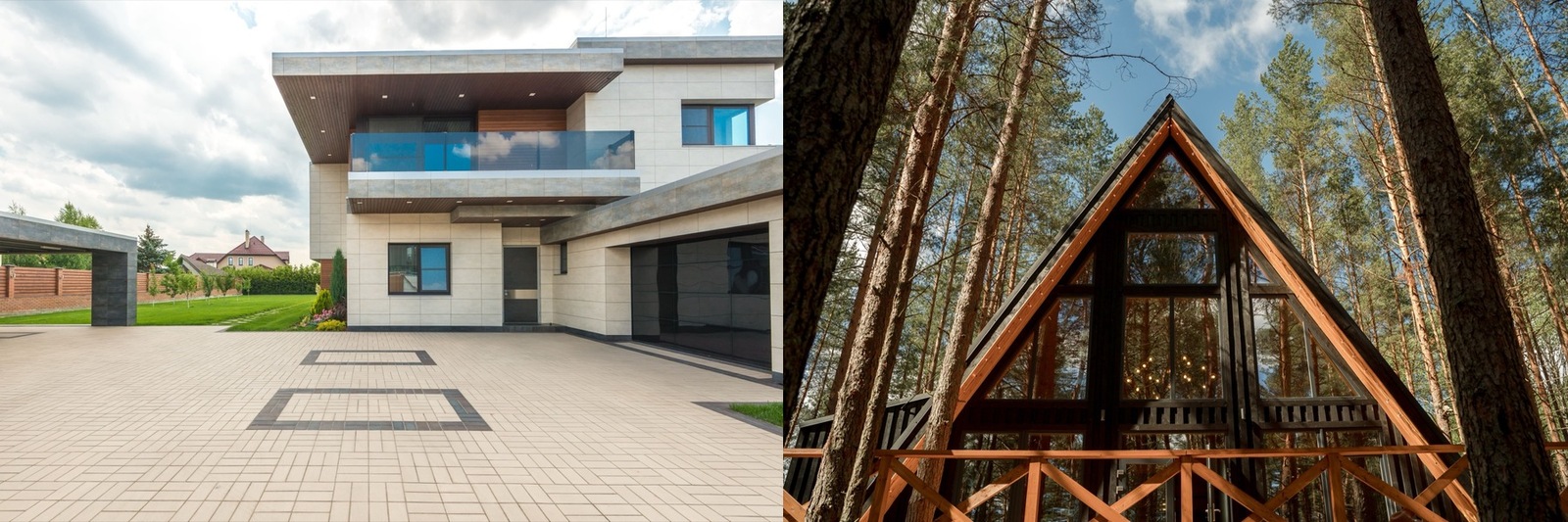
Walk a neighborhood in Panama and you'll see concrete. Walk one in the US and you'll see wood. That's not an accident, it's climate and economics. Reinforced concrete, block or poured, and wood stick-frame are the two dominant ways to build a house, and the right one depends heavily on where you're building.
The short answer
In a hot, humid, termite-heavy, hurricane-and-earthquake climate like Panama or Costa Rica, concrete wins for most homes. It ignores termites, does not burn, and shrugs off storms. Wood is faster, cheaper and easier to insulate where timber is cheap and the climate is mild, but it fights the tropics.
- Concrete costs 10% to 15% more to build in the US, roughly $25 to $50 per square foot on a block home.
- In Panama the maths inverts. Timber is imported and there is no stick-frame labour pool, so wood is the expensive option and concrete is the cheap default at $80 to $140 per square foot.
- Insurance is the line people forget. Concrete and ICF commonly earn a 15% to 25% premium discount, worth $1,000 to $3,000 a year on a coastal home.
- Maintenance runs about half. Roughly 0.5% to 1.5% of home value a year for block, against 1% to 3% for wood frame.
- Bare block is a thermal liability. Uninsulated it is around R-3. Insulated concrete (ICF) reaches R-20 to R-25 with no thermal bridging, which is the version worth building.
Line by line
| Factor | Concrete (block/poured) | Wood frame |
|---|---|---|
| Cost | 🟡 Higher material + labor | 🟢 Cheaper and faster where wood is cheap |
| Build speed | 🟡 Slower (cure time) | 🟢 Fast to frame |
| Termites | 🟢 Immune | 🔴 A prime target |
| Fire | 🟢 Doesn't burn | 🔴 Combustible |
| Hurricane / seismic | 🟢 Excellent (reinforced) | 🟡 Good if well engineered |
| Moisture / rot | 🟢 Unaffected | 🔴 Rots if it stays wet |
| Insulation | 🟡 Needs added insulation | 🟢 Easy cavity insulation |
| Tropical fit | 🟢 The regional default | 🔴 Fights heat, damp, termites |
What each one actually costs
This is where most comparisons go vague, so here are figures with their spread intact.
| Method | US total build cost / sq ft | Premium vs wood |
|---|---|---|
| Wood stick-frame | $175 to $350 | Baseline |
| Concrete block (CMU) | $200 to $400 | +$25 to $50/sq ft, about 10% to 15% |
| Insulated concrete forms (ICF) | $200 to $420 | About 10% to 20% |
Read cost claims carefully
The published range for the ICF premium runs from 5% to 60%, which is uselessly wide until you notice who is publishing. Form manufacturers and ICF builders cluster at 3% to 10%. Independent cost aggregators land at 10% to 60%. Both have a reason to sit where they sit.
Plan on 10% to 15% for block and 10% to 20% for ICF, and treat any single-figure quote you read online as marketing until a local builder bids your actual drawings. Labour availability moves this number more than material prices do.
The 30-year number, which is the one that matters
Build cost is a single payment. Insurance, energy and maintenance repeat every year for as long as you own the house. On a 2,000 sq ft home:
| Line | Wood frame | Concrete / ICF |
|---|---|---|
| Build cost at $200 vs $230 per sq ft | $400,000 | $460,000 |
| Annual maintenance (1% to 3% vs 0.5% to 1.5%) | $4,000 to $12,000 | $2,300 to $6,900 |
| Annual insurance, coastal | $6,000 | $4,500 to $5,100 |
| Annual cooling | Baseline | 20% to 30% lower |
| 30-year running costs, midpoint | ≈ $420,000 | ≈ $280,000 |
The $60,000 premium is recovered somewhere between year five and year twelve, depending mostly on your insurance market. A HUD analysis of insulated concrete construction found it added roughly $24 a month to total ownership cost once energy and insurance savings were counted, which is close to a rounding error on a mortgage.
The honest caveat: if you are going to sell in three years, none of this reaches you. Build cost is what you pay and resale is what you recover, and buyers do not reliably pay a premium for a wall system they cannot see. Concrete is a hold-the-house decision.
The insurance discount nobody quantifies
In hurricane markets this is frequently the largest single financial difference between the two, and it is almost never mentioned in comparison articles.
| Construction | Typical premium discount vs wood frame |
|---|---|
| Concrete block, general | 10% to 25% |
| Block rated "superior construction" | 15% to 30% |
| ICF, coastal high-risk zone | Up to 25% |
Homeowners in coastal markets report annual savings of $1,000 to $3,000. Model the conservative 15% to 25% rather than the 45% figure some Florida sources quote, because the headline number usually assumes several mitigation features stacked together rather than the wall system alone.
Two practical notes. Wind-rated garage doors with horizontal bracing can be worth up to a further 15% on their own, often for a few thousand dollars, which is the cheapest mitigation dollar available. And in Florida the discount is not automatic: a licensed inspector must complete form OIR-B1-1802 and it must reach your insurer before the first premium is paid. People build the right house and then forget to claim for it.
Performance, measured
| Measure | Wood frame | Concrete block | ICF |
|---|---|---|---|
| Wall fire rating | About 15 min bare, ~1 hr with drywall | 2 to 4 hr | 4 hr |
| Design wind resistance | Code-dependent, good if engineered | Very good | 200+ mph, 250+ with added rebar |
| Wall R-value | R-19 to R-21 (2x6 + fibreglass) | R-2 to R-4 bare | R-20 to R-25 |
| Thermal bridging | Yes, at every stud | Yes | None |
| Termites | Prime target | Immune | Immune (treat the foam at grade) |
| Rot and mould | Rots if it stays wet | Unaffected | Unaffected |
| Annual maintenance | 1% to 3% of value | 0.5% to 1.5% | 0.5% to 1.5% |
The R-value trap
A 2x6 wood wall at R-21 looks better on paper than a block wall at R-3, and this is the one argument where wood genuinely wins on the raw number. But two things complicate it.
First, the R-21 is nominal, not real. Every stud is a thermal bridge, and studs are roughly 15% to 25% of the wall area, so the assembly performs well below its stated rating. ICF has no bridge anywhere in the wall.
Second, R-value measures resistance, not thermal mass. A concrete wall absorbs heat during the day and releases it slowly, which flattens the indoor temperature swing. In a tropical climate with a small daily range that matters less than it does in a desert, but it still means a concrete house cools down and stays cool rather than tracking the outside air hour by hour.
The resolution is not to pick a side. It is to insulate the concrete. ICF gets you R-20-plus with no bridging and concrete's mass and durability at the same time, for roughly the same premium as bare block. If you are already paying for concrete, paying slightly more for insulated concrete is usually the better decision than either alternative.
Where wood genuinely wins
An honest comparison has to say this plainly, because for a great many houses wood is the correct answer:
- Speed. A crew frames a house in days. Concrete cures on its own schedule and cannot be rushed, which typically adds three to six weeks.
- Cost, where timber is cheap and labour is expensive. That describes most of North America, and it is the entire reason the US builds in wood.
- Cold climates. Where the job is keeping heat in rather than out, cavity insulation is easy, cheap and effective, and thermal mass works against you.
- Renovation. Moving a wall in a wood house is a weekend. In concrete it is an engineering decision.
- Seismic performance per unit weight. Wood is light and flexible. Properly engineered reinforced concrete performs excellently, but badly engineered concrete is far more dangerous in an earthquake than badly engineered wood, because the failure mode is mass falling.
- Warmth and character. Exposed timber does something to a room that block does not, which is why highland cabins are wood even in countries that build everything else in concrete.
What the choice comes down to
Wood is light, fast, cheap where timber is cheap, and easy to insulate, which is why it dominates North America. Concrete is heavier, slower, and pricier to build, but it's inert: termites, rot, fire, and storms don't faze it. In the tropics that inertness is worth a lot, because the climate is actively hostile to wood. Bare block insulates poorly, which is why insulated concrete like ICF is such a good tropical upgrade.
Choosing for your site
- Go concrete for a permanent home in the tropics: durability, storm and pest resistance, and financeability beat the higher build cost.
- Go wood where timber is cheap, labor is expensive, the climate is temperate, and speed matters, or for specific warm, characterful designs.
- Best of both: insulated concrete (ICF) gives concrete's toughness and the insulation wood does easily.
In the heat and rain
This is why nearly every home SORA builds is reinforced concrete. In Panama and Costa Rica it is the proven, insurable, financeable choice for heat, humidity, termites, hurricanes and earthquakes.
In Panama the cost argument reverses
Everything above about wood being the cheaper option assumes the North American context: abundant domestic timber, an enormous trained stick-frame labour pool, and a supply chain built around dimensional lumber. None of that holds in Panama.
| In Panama | Concrete | Wood frame |
|---|---|---|
| Cost per sq ft | $80 to $140 | Often higher, and highly variable |
| Materials | Cement and block made locally | Largely imported, with duty and freight |
| Labour | Every crew builds this way | Specialist, scarce, priced accordingly |
| Bank financing | Standard | Frequently difficult |
| Insurance | Straightforward | Can be hard to place near the coast |
| Termite pressure | Irrelevant | Year-round and severe |
So the tropical answer is not simply "concrete is more durable, pay the premium." In Panama there is usually no premium to pay. Concrete is cheaper to build, easier to finance, easier to insure and lasts longer. The interesting question locally is not concrete versus wood at all, it is bare block versus insulated concrete, and that one turns on your electricity bill.
Wood keeps its place in accents, ceilings, decks, some highland cabins, and bamboo as a sustainable option. As the primary structure of a permanent tropical home, concrete is the pragmatic winner. See our 2026 cost-to-build breakdown for the full line-item picture.
Sources & the cost-claim caveat
Verified 12 August 2026. Cost figures are US national ranges unless stated; Panama figures come from our own project data in Chiriquí and the Azuero peninsula.
- US cost-per-square-foot ranges cross-checked across independent cost aggregators and builder bids, with the manufacturer-versus-aggregator spread noted in the text rather than averaged away.
- Wind and fire ratings from ICF manufacturer test data and Florida Building Code High-Velocity Hurricane Zone requirements (170 to 200+ mph coastal).
- Ownership-cost comparison from the US Department of Housing and Urban Development analysis of insulated concrete form construction.
- Insurance discount ranges from Florida carrier guidance; the OIR-B1-1802 mitigation form requirement is set by the Florida Office of Insurance Regulation.
Where a figure is a range we have kept it a range. Anyone quoting a single national number for the cost of a wall system is selling something.
Weighing this for a real project?
SORA builds fixed-price homes for foreign buyers in Panama and Costa Rica. We match the method and material to your site, budget, and how long you plan to keep the house, and tell you straight when the cheaper option is the smarter one.
See 2026 build costs →Frequently asked questions
How much more does a concrete house cost than wood?
In the US, budget 10% to 15% more for concrete block, which is roughly $25 to $50 per square foot, and 10% to 20% more for insulated concrete forms. Published figures range from 5% to 60%, but that spread mostly reflects who is publishing: form manufacturers quote the low end, independent cost aggregators the high end. In Panama the comparison reverses, because timber is imported and concrete is the local default at $80 to $140 per square foot.
Do you get an insurance discount for a concrete house?
Usually yes, and in coastal markets it is often the largest financial difference between the two. Typical discounts run 15% to 25% against wood frame, worth $1,000 to $3,000 a year on a hurricane-exposed home. In Florida the discount is not applied automatically: a licensed inspector must complete form OIR-B1-1802 and submit it to your insurer.
What is the R-value of a concrete wall?
Bare concrete block is only about R-2 to R-4, which is its real weakness. Insulated concrete forms reach R-20 to R-25 with no thermal bridging anywhere in the wall. A 2x6 wood wall is nominally R-19 to R-21, but studs bridge 15% to 25% of the wall area, so the assembly performs meaningfully below its stated rating.
How long does a concrete house last compared to wood?
A well-built wood-frame house lasts 50 to 100 years with consistent maintenance. Reinforced concrete routinely exceeds 100 years, and the difference widens sharply in the tropics, where termites, rot and humidity attack wood continuously. Annual maintenance runs about 0.5% to 1.5% of home value for concrete against 1% to 3% for wood frame.
Is a concrete or wood house better in the tropics?
Concrete, for most permanent homes. It's immune to termites, doesn't burn, resists rot, and stands up to hurricanes and earthquakes, all things a hot, humid, storm-prone climate throws at a house. Wood is cheaper and faster where timber is inexpensive and the climate is mild, but it fights the tropics.
Is a concrete house more expensive than wood?
Usually to build, yes, since concrete uses more material and labor and cures slowly. But in the tropics that upfront cost buys much lower losses to pests, fire, and storms over the building's life, plus easier insurance and financing, so the lifetime economics often favor concrete.
Do concrete houses stay cooler than wood ones?
A bare concrete or block wall has thermal mass but no insulation, so it can hold heat. Insulated concrete methods like ICF combine concrete's durability with continuous insulation, giving cooler, steadier interiors than either an uninsulated block wall or a typical wood-frame house.
Sources & verification
Figures in this guide were checked against primary and authoritative sources on 27 July 2026. Immigration, tax, and cost figures change — always confirm the current rules with the official body or a licensed professional before acting.