Moving to Puerto Rico in 2026
A US territory you can move to on a one-way ticket, no visa required. Act 60 just changed, and there is a hard deadline on 31 December 2026 that decides whether you pay 0% or 4% for the next two decades.
Quick take
- ImmigrationNone. If you hold a US passport you move the way you move between states.
- The deadline31 December 2026. File your Act 60 application by then for 0%. After that it is 4%.
- The trade0% expires in 2035. The new 4% rate is locked until 2055. Longer, not just cheaper.
- New stringsBuy a home within 2 years, donate $10,000 a year, and prove 6 years of prior non-residency.
- Cost of livingCheaper than a US metro, not cheap Caribbean. Median home around $290K to $308K.
- Watch out forThe power grid. A generator is equipment, not a luxury.
Puerto Rico is the rarest thing in the Caribbean for an American: a move with no immigration process at all. It is a US territory, so a US citizen buys a one-way ticket, lands in San Juan, and starts living there the way they would move from California to Texas. No visa, no work permit, no customs line. Combine that with the island's Act 60 tax incentives and you get the wave of mainland arrivals of the last decade. In March 2026 the rules were rewritten, and if you are reading anything published before then, it is wrong about the part that matters most.
The residency question: there barely is one
For US citizens, permanent residents, and US nationals there is no visa and no residency application, because none is required. Your citizenship does not change, your passport does not change, and you do not clear immigration on arrival.
The nuance is tax residency, which is a different thing from living there. To unlock the island's tax advantages you must be a bona fide resident under IRS rules: broadly, at least 183 days a year on the island, your primary home and closer connections there, and no tax home elsewhere. Living in Puerto Rico is trivially easy for an American. Qualifying for its tax benefits is a real relocation with real tests, and the IRS keeps a live enforcement focus on people who claim it without meaning it.
Act 60, and the deadline that decides your rate
The old shorthand of Act 20 and Act 22 has been out of date since 2020, when both were folded into Act 60, the Puerto Rico Incentives Code. Two pieces matter to someone moving from the mainland:
- Export services (formerly Act 20): a qualifying business exporting services from Puerto Rico pays a 4% corporate rate on that income.
- Individual investors (formerly Act 22): a bona fide resident holding a valid decree has historically paid 0% Puerto Rico tax on interest, dividends, and capital gains earned after the move.
Underneath both sits IRC section 933, which exempts bona fide Puerto Rico residents from US federal income tax on Puerto Rico-source income while they remain US citizens. That combination is why fund managers, online-business owners, and a great many crypto investors have been buying plane tickets since 2012.
Then, on 10 March 2026, Governor Jenniffer González-Colón signed Act 38-2026, which extended the program's sunset from 2035 all the way out to 31 December 2055 and reset the terms for everyone who applies from 2027 onward. It is the first meaningful change to the rate since the program was created.
The Act 60 fork
Applies to interest, dividends, and capital gains earned after you establish residency. Post-2026 applicants also face 5% on certain pre-residency long-term gains.
The deadline is earlier than it looks
Decree applications go through the DDEC, and processing routinely takes several months or longer. A complete application has to be submitted before 31 December 2026, so working backward from a December filing date is how people miss this. If the 0% rate is the reason you are moving, this is a third-quarter decision, not a Christmas one.
Note what the trade actually is, because the 4% is not simply worse. The 0% rate expires in 2035. The 4% rate is guaranteed to 2055. You are choosing between nine years of nothing and twenty-nine years of four percent. For anyone under fifty, the arithmetic is not obvious.
What the new rules ask of you
Applicants filing from 2027 onward face a tighter set of conditions. Three of them are worth planning around now:
- Six years of prior non-residency. You must show you were not a Puerto Rico resident for at least six years before relocating. That is actually a shorter lookback than the ten years required today.
- Buy a home within two years. The decree holder must acquire Puerto Rico real estate as their primary residence within two years, and for post-2026 applicants that ownership must be recorded, or pending recording, in the Puerto Rico Property Registry. Long-term renting no longer satisfies the program.
- Donate $10,000 a year. To local nonprofits certified under the Puerto Rico Internal Revenue Code, and not controlled by you.
The builder's read
The home-purchase clause is the one people underestimate, and it is the reason we pay attention to this program at all. It is no longer a tax move with a housing footnote. Buying is a condition of the benefit, on a two-year clock, with a registry filing that has to actually clear.
Two practical consequences. First, Puerto Rico's title and registry process is slower than mainland buyers expect, so a purchase that closes in month twenty-two may still not be recorded in time. Start earlier than feels necessary. Second, this creates a floor of motivated buyers in specific towns, which is worth knowing whether you are buying to live or watching the market.
If you already hold a decree
Existing Act 60 and Act 22 decrees are grandfathered unless revoked, and stay valid through 31 December 2035. They are not automatically extended to 2055. You may renegotiate into the new regime, now or later, trading your 0% for 4% and twenty extra years.
Whether that is a good trade depends entirely on your age, your horizon, and what you expect to realise between now and 2035. That is a conversation with a Puerto Rico tax professional, and it is worth having before 2035 sneaks up rather than after.
What it costs, honestly
Puerto Rico is meaningfully more affordable than major mainland US cities, especially real estate, where San Juan prices are a fraction of New York, LA, or Miami. But it is not a budget Caribbean destination on the level of the Dominican Republic. Costs swing hard by location.
| Item (San Juan metro, 2026) | Typical figure | Note |
|---|---|---|
| Studio / 1-bed rent, central | ~$1,300/mo (median) | Higher in Condado, Dorado, Rincón |
| Median home purchase | ~$290,000–$308,000 | A fraction of comparable US-metro prices |
| Comfortable single budget | $2,000/mo can feel tight | In San Juan, Rincón, or Dorado once utilities/groceries are in |
In smaller towns and quieter coastal areas many expats live comfortably for less; in metro San Juan, tourist hubs, or upscale Dorado, budgets stretch. Utilities deserve special attention: the island's power grid is unreliable, and a backup generator plus, in some areas, a water cistern are considered essential rather than optional.
Where people settle
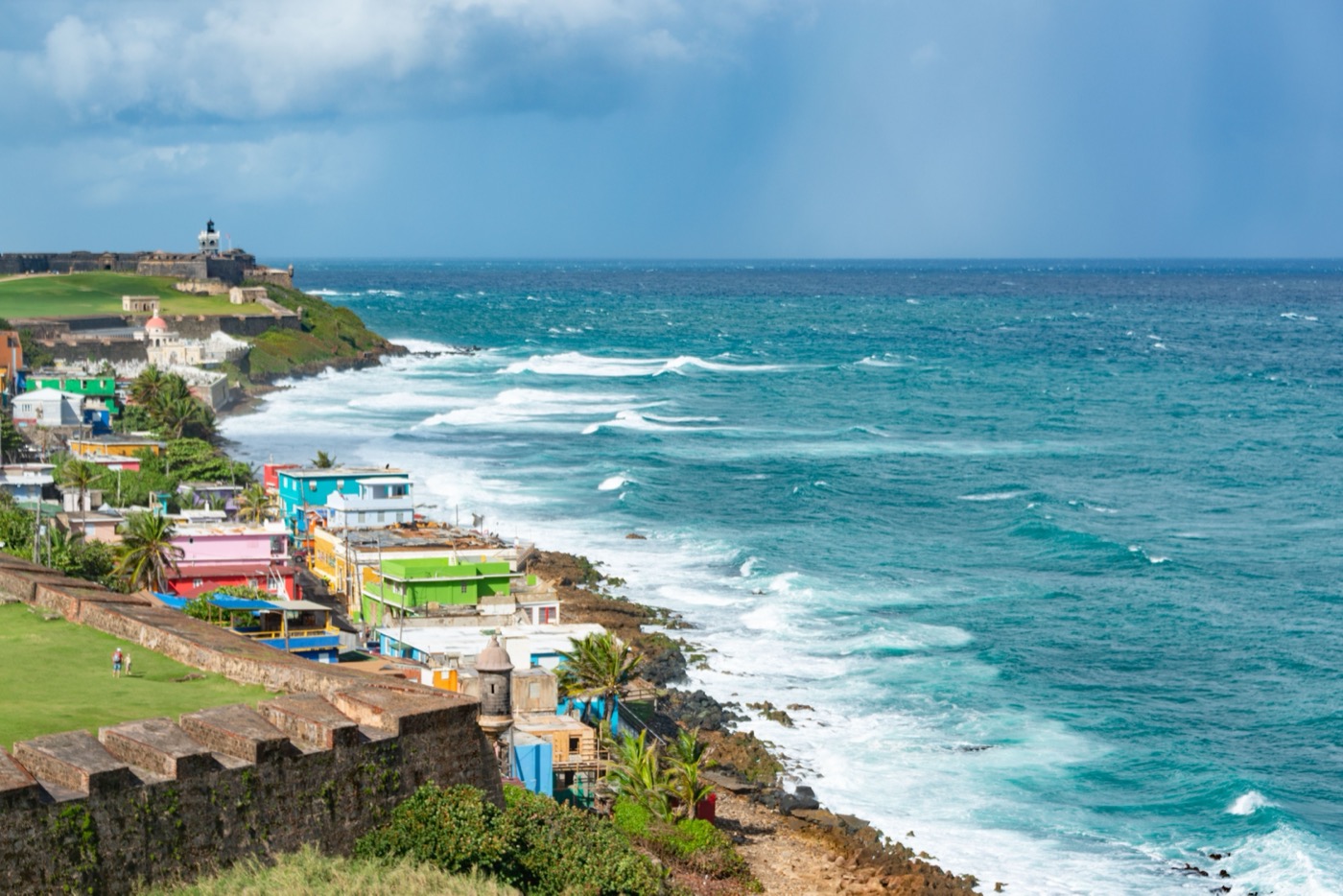
San Juan metro, Condado, Miramar, Ocean Park, Old San Juan, Isla Verde
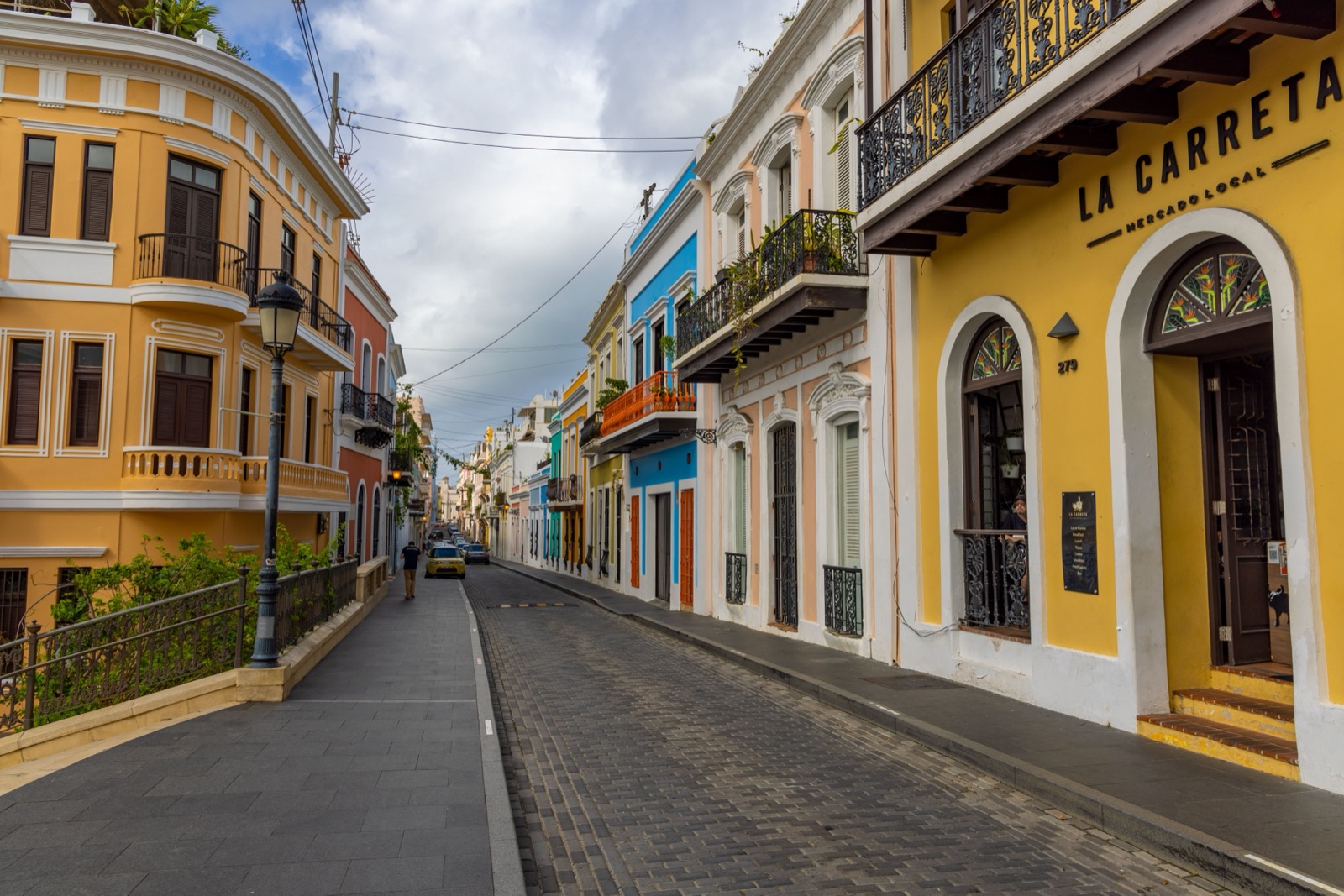
The city-meets-beach option, popular with remote workers and families. Old San Juan is historic and walkable; Condado and Ocean Park are waterfront and amenity-rich. Best for people who want services, nightlife, and the shortest learning curve.
Dorado, upscale suburb, ~25 miles west
Gated communities, resorts, golf, and some of the best private healthcare on the island. The most expensive end of the market, favored by Act 60 professionals and retirees who want comfort and will pay for it.
Rincón, west-coast surf town
A laid-back surf town of roughly 13,000–15,000 that has become a “little slice of America,” with a strong community of surfers, artists, retirees, and remote workers. Lower cost and slower pace than the metro, at the expense of big-city services. Other options: Aguadilla (affordable, family-friendly), Ponce (traditional, cultural), Palmas del Mar in Humacao (gated resort community with bilingual schools), and Vieques/Culebra for small-island solitude.
Safety, healthcare & connectivity
Safety. As a US territory, Puerto Rico gets no formal State Department travel advisory (third-party trackers treat it as Level 1, normal precautions). Crime is higher than the US average in some areas, and parts of San Juan (and La Perla) warrant caution, but the developed residential and expat areas (Condado, Isla Verde, Ocean Park, Dorado, Guaynabo, Palmas del Mar) feel considerably safer, with more private security and community networks. Neighborhood selection matters more here than in many destinations.
Healthcare. Private clinics and hospitals, concentrated in San Juan, Ponce, and the west coast, offer modern, bilingual, often US-trained doctors at prices below the mainland, and US medical licenses are recognized. One critical caveat: even though Puerto Rico is a US territory, not all stateside insurance plans cover routine care there. Call your insurer before moving, and confirm availability of any regular prescriptions.
Internet & remote work. High-speed internet is solid in San Juan and the main cities but can be patchy in rural areas, and fiber is limited, so check connectivity for your specific address before committing. Fully-remote workers can range further afield (Rincón, Aguadilla, Ponce, even Vieques); those who need frequent San Juan access cluster in Condado, Ocean Park, Miramar, Isla Verde, Guaynabo, or Dorado.
Resilience is the 2026 watchword
Hurricane Maria (2017) and Fiona (2022) exposed how fragile the grid is. When scouting a home, check for an independent water cistern and a backup generator. In 2026, “resilient living” has become the standard, and a beautiful beachfront loses its charm fast without reliable power and water.
Is Puerto Rico right for you?
- Great fit if: you're a US citizen who wants a no-paperwork move, English gets you by, you value proximity to the mainland, and, for high earners, the Act 60 math works even under the 2026 rules.
- Think twice if: you want rock-bottom Caribbean costs (the DR is cheaper), you can't tolerate grid/hurricane disruption, or your income wouldn't meaningfully benefit from the tax regime (in which case the residency tests and home-purchase requirement are cost without upside).
Act 60 now requires you to own the home, not rent it
A two-year clock and a Property Registry filing turn a tax decision into a construction and closing timeline, which is a different kind of problem. SORA designs and builds homes across the tropics, with our deepest roots in Panama and Costa Rica, where residency is straightforward and building costs a fraction of the coastal Caribbean. If the move is really about a place of your own in the sun, it is worth seeing what a fixed-price build looks like before you commit to any one island.
Frequently asked questions
Can Americans move to Puerto Rico without a visa?
Yes. Puerto Rico is a US territory, so US citizens, US permanent residents, and US nationals can move there with no visa, no work permit, and no immigration process, the same as moving between US states. Your citizenship and passport are unaffected.
What is Act 60 and how did it change in 2026?
Act 60 is Puerto Rico's consolidated incentives code (it absorbed the former Act 20 and Act 22 in 2020). It offers a 4% corporate rate for export-services businesses and, for individual investors who become bona fide residents, historically 0% tax on interest, dividends, and capital gains. In 2026 three things changed: applications must be filed by December 31, 2026 to keep the 0% individual-investor rate; new applicants from January 1, 2026 pay 4% instead of 0%; and residents must buy a primary home within two years of their decree.
How much does it cost to live in Puerto Rico in 2026?
It's cheaper than major US cities but not a budget Caribbean island. In central San Juan a studio or one-bedroom rents for around $1,300/month (median) and median home prices run roughly $290,000–$308,000. A $2,000/month single budget can feel tight in San Juan, Rincón, or Dorado once utilities and groceries are included; smaller towns are more affordable.
Is Puerto Rico safe for expats?
Crime is above the US average in some areas, and parts of San Juan warrant caution, but the main residential and expat neighborhoods (Condado, Isla Verde, Ocean Park, Dorado, Guaynabo, and Palmas del Mar, feel considerably safer and have stronger community and private-security networks. Neighborhood choice is the key variable.
Do I still pay US federal taxes if I move to Puerto Rico?
Bona fide residents of Puerto Rico are exempt from US federal income tax on Puerto Rico-source income under IRC §933, while remaining US citizens. Income from mainland or foreign sources can still be federally taxable, and qualifying as a bona fide resident requires meeting strict IRS tests (roughly 183+ days a year on the island plus a genuine closer connection). Professional tax advice is strongly recommended.
Sources & verification
Figures in this guide were checked against primary and authoritative sources on 27 July 2026. Immigration, tax, and cost figures change, so always confirm the current rules with the official body or a licensed professional before acting.
- Puerto Rico DDEC, Incentives (Act 60) · official administrator of Act 60 tax decrees
- IRS, Bona fide residents of Puerto Rico · federal rules under IRC §933 / §937 residency tests
- US State Department, Puerto Rico · no formal advisory for the US territory (trackers treat as Level 1)
- Grant Thornton Puerto Rico · Act 38-2026 tax alert: extension and changes to resident-investor benefits
- Procopio · Act 60 extended to 2055 and the new 4% regime for future applicants